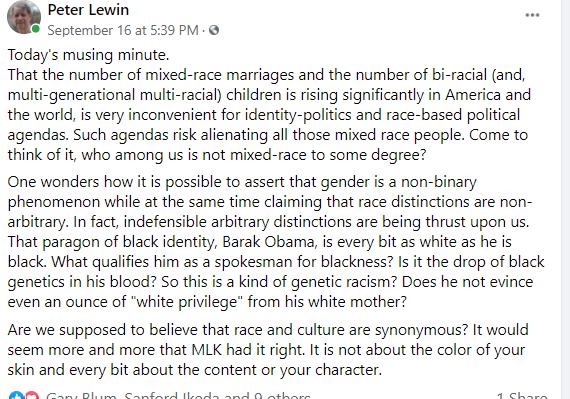
This is where Dennis Prager loses me.
I always seem to be in the minority, on the outside, swimming against the current.
Friday, September 24, 2021
Today’s musing minute: Dennis Prager on religion and freedom.
Saturday, September 18, 2021
Saturday, September 11, 2021
The power of foreign policy counterfactuals
Today’s musing minute: The power of foreign policy counterfactuals.
Arguing about foreign policy consciously or unconsciously implies arguing about history, usually fairly recent history. And arguments about history imply some level of expertise and a great deal of familiarity with mountains of details, an understanding of local contexts, and a grasp of the inevitable complexity of the particular social situations. Which is why I feel exasperatingly lost in such discussions.
Key to any argument about particular foreign policy actions or strategies, are the myriad of counterfactual assumptions one has to make to advance any claim. Thinking about the recent US departure from Afghanistan, I was struck by a particular example of this.
Those of us who feel intuitively that foreign adventures in nation building are extremely ill-advised and immoral are often hard pressed in concrete situations to justify our position in cost-benefit terms. Consider Afghanistan. Yes, our occupation cost a bloody fortune. There was loss of life of American soldiers, inefficiency and corruption. But, for twenty years, the lives of ordinary Afghans were better than they would have been (note the italics) had the US not been there to protect the government that succeeded the deposed Taliban regime. And now, that we have left, though the future is uncertain, perhaps it was worth it.
You see the problem? We don’t really know what would have happened (the counter factual) had we (the US) fulfilled the mission of routing Al Qaeda and found a way to withdraw, with dire warning about any further collaboration with that group, who knows how long the Taliban would have been able to hang onto power? Even now, while the picture is bleak and expectations are anxious, maintaining a stringent theocracy is a costly business and the costs mount up over time. Will Afghanistan go the way of Iran and Pakistan, or will it look more like North Vietnam. What would have been and what will be? Choose your counterfactual and you can justify just about any policy scenario.
What that tells me is that, given the incentive and
knowledge problems in any large foreign policy adventure, abstinence is the
better part of valor.
Saturday, August 28, 2021
Sunday, August 22, 2021
Wednesday, August 18, 2021
Saturday, August 7, 2021
Sunday, May 30, 2021
The simple economics of diversity, equity and inclusion
Driving in the car listening to the BBC show The Real Story I found myself getting increasingly more angry and frustrated at what I was hearing. An interviewer and three talking heads we're discussing the significance of the recent embrace by corporate America of the new diversity, equity and inclusion, DEI, agenda. The arrogant , self-righteous, ignorance of any semblance of economic understanding was infuriating.
So, there is always the possibility that it is just rhetoric, portending no actual change in business as usual. In which case my talking heads were expending wasted energy. What, however, if it did lead to some sort of concrete change in the way that these corporations do business? In that case, I told myself, I should investigate the possible consequences before allowing myself to get uncontrollably angry. So here goes, what is the basic economics of DEI?
As I see it there are a number of significant possibilities.
First, we must consider what the effects of adopting what for simplicity we will simply refer to as the DEI policy agenda are, whatever that may actually mean (quotas ensuring “adequate” representation of all designated protected racial or ethnic groups in the workforce, ensuring they are paid “equitably” and who the hell knows what “inclusion” is?). Some Progressive champions of DEI would have us believe that it is actually “good for business”, that it actually would boost, not reduce, profits. The believability of this assertion is indistinguishingly close to zero, But, were it true, there would be nothing to worry about. No trade-off involved. Those businesses who played DEI ball would come to dominate the marketplace at no cost in profits earned and everybody would be happy. So much for fantasyland.
In the real world, however, DEI policy will imply an increase in the costs of production, leading to higher prices, lower revenues and, most significantly, lower profits. For Progressives this is a good thing, because profits are a bad thing. Unfortunately, however, those nasty shareholders demand profits in return for investing in production. Lower profits, less investment, less jobs, etc. So the apparent benefits of DEI come at the expense of profits and investment – and also higher prices – which certainly hurts poor people as well as, and probably more than, rich ones, But, assuming, as we must, that DEI has real costs, that there is, indeed, a real tradeoff, what will be its long-term effects?
In particular, there are two polar possibilities.
At one extreme, Case 1, the shareholders and management of the relevant companies and all the current and potential consumers of their products all succumb to the DEI story and change their attitudes, all becoming true believers. In this scenario, no company is punished in the marketplace by consumers for the increase in costs and prices that occurs as a result of adopting DEI. The consumer is boss, and if consumers reward companies for being DEI compliant and punish those that are not, all companies will follow suit. To be sure, costs and prices will rise, production and employment will fall, but, hey, everyone will be happy because they consider it worth it in terms of the social justice benefits conferred by DEI. Who am I to argue with that?
At the other extreme, however, Case 2, suppose that
consumers don’t give a fig about DEI, that when it comes to actually making
purchasing decisions for valued products, they will choose the lowest price
regardless of the company’s DEI credentials; then, regardless of what the
shareholders and management believe, those companies that adopt DEI policies
will be at a competitive disadvantage against those that do not, and the latter
will soon outcompete the former. The rhetoric may remain, but actual practice
(regardless of attitude) will follow the money.
The reality is probably some mix between cases 1 and 2, with some consumers conscious of and prepared to pay more for DEI compliant products and some not. And the larger the latter group (it is likely to be the much larger group) the less likely any real damage from DEI stupidity.
This is very reassuring. It means, even if the corporate executives, managers and shareholders believe the DEI nonsense and try to implement it, unless enough consumers are prepared to bear the cost burden implied, their DEI efforts will be punished and probably abandoned in short order. In fact, since they are not stupid, company policy-makers will have figured this out making any real costly changes more unlikely.
This made me feel much better. But, perhaps only for a moment, because then the realization dawned. This being the case, the determined Progressive social engineers, seeing the hypocrisy of their corporate allies, will seek and obtain overbearing coercive social regulation to enforce and monitor the implementation of DEI policies imposing severe penalties for violations. At the end of the day our virtuous Progressives are brutal dictators after all. That is why this whole thing is so scary. Lets hope it does not come to that.
Saturday, May 22, 2021
Because or despite
Today’s musing minute
Because or despite.
The plea to “listen to science” seems both noble and sensible, as in, what to do about covid-19. But the “science” never, by itself, gives us a complete answer about what to do. And that is true even if we are agreed on the objective we want to achieve. This is because the “science”, the facts, never speak for themselves – and that is even if we agree on what the relevant facts are. The reason is facts need to be interpreted, and interpretation is a tricky business – subjective, dependent on prior knowledge and experience, including what one has been taught, what one believes is the correct framework of interpretation. The *framework of interpretation* is key.
At the heart of the ambiguity is the role of counterfactuals, the “what might/would have been”. The same set of facts in the social world (district from the facts of natural science where controlled experiments are often possible) are often interpreted in diverse, often diametrically opposed, ways. This is the “because or despite” phenomenon.
Example: What was the cause of the 2008-9 financial crisis? Two popular answers are 1 or 2.
- Insufficient regulation of financial activities (the counterfactual claim: if speculation and greed and been properly regulated it would not have occurred – it occurred *because* of insufficient regulation).
- Too much regulation of financial activities (the counterfactual claim: if mortgages had not been subsidized and capital flows distorted by mortgage regulations to increase homeownership it would not have occurred – it occurred *despite* substantial regulation (and actually *because* of that regulation)).
Another example: What explains the amazing increase in global wealth 1945 – 2015? Two possible answers are 1 and 2.
- The appropriate expanding role of wise government policy (Keynesian economics and “market-failure” regulation) – it occurred *because* of expanding regulation – the counterfactual claim being, absent which it would not have occurred. The regulation is a tailwind.
- The expansion of world trade *despite* the inhibiting costs of expanding government regulation – absent which it would have been even greater. The regulation is a headwind.
The vast majority of disagreements about economic policy and public administration are like this. They revolve around opposed interpretive frameworks, in particular, frameworks that see the effects of government policy in opposite ways, and, therefore point to diametrically opposed implications for the appropriate role and scope of government intervention in the economy. Constructive (even civil) conversation is impeded by the difficulty of deciding which of any competing counterfactual claims is the most likely. Sometimes the evidence weighs heavily in favor of one or another, but often not.
A significant example is the very idea of Socialism. The “science” tells us that wherever it has been attempted it has failed miserably (without exception), unless you believe that it actually has never been implemented properly (counterfactual claim: What started in Venezuela, N. Korea, China or Russia as socialism, deteriorated into dictatorship. This need not have happened, and if it had been “done properly” socialism would have been a success. Therefore we conclude the science does not tell us it is doomed to fail. Bravo Bernie! So much for the science.
Saturday, March 13, 2021
Today's musing minute - some big picture observations
Some big picture thinking. Feeling very sad and frustrated and trying to figure out why.
There is a certain grieving process that comes with the realization that valuable wisdom has been lost.
One does not have to believe naively in the good old days to realize that there was a time in America, not so long ago, when most people understood in basic terms how markets worked. Millions flocked to this country to pursue the opportunities available from largely free markets. There was a basic understanding, an adult understanding, that the way out of poverty was through the enhancement of individual abilities. Hence the commitment to education and hard work.
Up until the twentieth century there was a widespread suspicion of government, of its ability to “fix” social problems, and of its susceptibility to corruption and of false beliefs in its prowess. And though the size of government was creeping up throughout the nineteenth century, it was the Great Depression and FDR that really punctured this basic understanding. The events that led to this sea change were the creation of the Federal Reserve System in 1913, which precipitated the boom of the 1920’s, aggravated the bust that followed and then facilitated the accelerating growth of government that has been the lingering response to it. The widespread myth that the New Deal was the cure for the Depression and the foundation of a more solid approach to economic policy, is almost universal among Americans living today, and is part of the conventional wisdom embedded in the history textbooks used to educate our children.
This “new economics”, supported by the “Keynesian revolution” that invented macroeconomics, became the new orthodoxy that undergirded economic policy. JFK could unselfconsciously commit to “balancing the economy” rather than worrying about “balancing the budget” and Richard Nixon could famously declare “we are all Keynesians now”. Old style fiscal responsibility was thought to have been unnecessary and actually irresponsible. A new vision for what was possible and necessary for government to do had displaced it. And with a vengeance, with a euphotic commitment by LBJ to create a “Great Society”, to banish poverty forever.
The heady days of the civil rights era of the 1960’s heralded a massive expansion in government spending and responsibility – with three wars, the war in Vietnam (to make the world safe for Democracy), the war against poverty and the war on drugs. All three of these “wars” have been lost, but this has been admitted for only the first (America lost the Vietnam war, but won the peace as Vietnam has been conquered by the American example of free-enterprise to become one of the fastest developing countries of the region).
The war on poverty has apparently been lost. How else to explain that some fifty years after it was declared, we have more anti-poverty programs on the books than ever? The new $2trillion relief bill is adding still more. And the war on drugs has been lost as well. The number of users and producers has increased and the costs of this “war” - monetary, emotional, social and political - are out of control. Ironically, these two wars are themselves responsible for the perpetuation of poverty where it still exists. To be sure, poverty in America and in the world, has decreased dramatically, and continues, in a non-pandemic world, to do so. But this is a result of growing world trade, in spite of welfare-state anti-poverty dependency-creating programs, debilitating crime-producing drug wars, and abysmal failures of public education, not because of them.
A glimmer of hope came in 1980 with the election of president Ronald Reagan (and Margaret Thatcher in the UK). With all the imperfections that attended the Reagan terms, it was a time of recurrent disillusionment about the promise of big government policies. Reagan’s proclamation that the “government is the problem not the solution” resonated loudly and got him elected at a time of high unemployment and inflation that was attribted to the failure of the “new economics” and promised a return to the wisdom of an earlier period. This coincided with my own story. I was (1972-6) a Ph.D. student at the University of Chicago, thoroughly disillusioned with the performance of Keynesian economic policy and encouraged later by Reagan’s election. I naively believed that the “experiment” of the post-war period had once again shown the wisdom of classical liberal economic policy.
I think it is true to say that the post-Reagan period of the twentieth century, dubbed the “Great Moderation”, was one, not only of sustained and stable economic growth, but was also one of relative unity and consensus among Americans at large. Of course, the usual divides regarding the proper role of government and related matters continued to energize popular and intellectual discussions. But it was, certainly relative to today, a period of peaceful public discourse to accompany the enduring prosperity being experienced. This came to an end with the recession beginning in March of 2001. The end of the Great Moderation is popularly dated as the onset of the Great Recession in late 2007, but I believe this is wrong and the economic fluctuations during the period 2001-2008 are connected. To my consternation, George Bush, the younger, articulated a return to discredited Keynesian economic policy in order to deal with the dot.com bust and the recession starting in 2001. And from that time onward it has been downhill toward an accelerating embrace of big government policies accompanied by an accelerating and deafening deterioration in abusive public discourse.
It needs to be noted that for all the reassurances of the Reagan-Bush-Clinton period, only minor progress was made at dismantling the overbearing welfare-state apparatus that the Great Society had created. Reagan succeeded in partially reforming the tax structure, and Clinton succeeded in significantly reforming much of the welfare system by making the states responsible for them. But, perhaps, this failure to affect most of the welfare-state apparatus, was somewhat obscured by the Great Moderation. It was clear, however, that the war on poverty was not working, and, in fact, had made things worse. Poverty in America is disproportionately significant among black families. The data unambiguously show that from the mid-1960’s onwards, the financial health and security of black families has, on average, declined – by any of the common metrics one chooses!
It was the Obama administration, succeeding the ineffectual and disruptive Bush Jr. presidency, that constituted the real beginning of a ramping up of the earlier trend toward big government macroeconomic and welfare-state programs, and, significantly, with it, the concerted attempt to demonize everything that came before that smacked of any disagreement with the Progressive turn. Obama seemed incapable of making any presidential pronouncement without alluding to, what he saw as, the deep fundamental racial, economic, gender, fissures that characterized American society. Obama, coming to power on the promise of being the eloquent unifier, turned out to be the most divisive president of the post WWII period – up to that point. We should not forget just how superciliously, subversive his pontifications were in helping to sow the seeds of the resentment, envy and victimhood, that gets worse by the day.
Notably, Obama started reversing and now Biden is in the further process of reversing, the Clinton era achievements which dramatically reduced the welfare rolls. And we should not forget the fiasco of Obamacare that continues to plague us.
Donald Trump was not so much a perpetrator of division, though he certainly was that, as the crudest and most primitive reaction to it. He was elected by a festering anger at the “excesses” and “heresies” of the Obama administration and the promise of more and worse to come from Hillary. In that perspective, Trump was a tumultuous reactionary and temporary hiatus in the march toward the society of woke recrimination and Q’anon insanity.
And now, the goofy Biden is dancing to the tune of the vigorously ascendant Progressives. The $2T relief bill embodies some, but by no means all, of the looming agenda. Just the other day Paul Krugman (in the increasingly woke NYT) triumphantly declared that the days of “government is the problem not the solution” are over. And, most reasonable people tragically do not have a clue as to what it really represents. And I find myself at a loss to explain it to them. They won’t do the work necessary to understand it. They see it as a hodgepodge of partly reasonable compassionate legislative initiatives, albeit partisan in motivation (but what else is new?) that reasonable people can disagree about, but not as any subversion of fundamental American principles that could do much harm. The truth is that while world trade will hopefully continue to grow, and poverty generally will continue to decline, certain elements of our population, the most vulnerable and long suffering, will have their progress inhibited, sometimes prevented, by the Progressive destruction of adult economic and social policies. They will be rendered even more dependent on the state, more patronized, facing fewer opportunities for advancement, in an economy whose growth will be stifled by high taxes and financial instability.
This is what makes me sad and frustrated.
Sunday, February 21, 2021
On reading Buchanan's "Cost and Choice" for the third time.
I just finished reading Jim Buchanan's Cost and Choice for the third time. I continue to learn from each reading, with no diminishing returns.
Thursday, January 14, 2021
Today's musing minute - impeachment should be about constraining the role of government.
|
Mainly for my non-libertarian (classical liberal) friends. Make no mistake, the distressing political pathology that we are seeing in the end comes down to one basic thing - the size, power and scope of government. Deficits, and levels of debt are bad, but (as Milton Friedman reminded us) it is more fundamentally the extent of government that matters. A small limited government has less power and is less of a target for influence by big business and popularist social groups. Representative democracy only works when the government's powers are clearly and firmly constitutionally constrained. The story of at least the last one hundred years is the steady erosion of these constraints with the predictable effect of entrenching and expanding a powerful ambitious non-elected machinery of government. The progress is steady, but each major crisis has accelerated it. They may have the moral high ground on impeachment, but for the wrong reasons, and within a concept of government that is the opposite of what they are supposed to be impeaching Trump to defend. Trump's most obvious
transgression was to maintain and encourage his followers to believe that the
vice president, together with Republican loyalists, could and must nullify
the election in his favor. But, in his campaign
promise to "drain the swamp" he has manifestly failed. Instead, the
government leviathan monster rises ascendant with this public spectacle and
exacerbates a deeply divided population, a population divided not over the appropriate
role of government, but more mundanely simply over who should be in control
over that government in order to push their particular bloated agenda. A ubiquitously intrusive government is inevitably corrosive of both freedom and prosperity. Unfortunately, most people who feel the loss of prosperity never realize that its cause lies in the loss of freedom, yet that widespread realization is the only hope of reversing this trend.
|
Monday, January 11, 2021
Today's musing minute - they're back !!
Today's musing minute.
Wednesday, January 6, 2021
Thoughts in the wake of this momentous day in America. Warning: long post.
In the days and weeks to come, commentators will point out that what happened today was the culmination of a set of pathologies on both sides of the political spectrum. Yes, Trump and his followers high and low, sincere and expedient, share blame (as do those who encouraged and excused earlier left-wing, widespread and enduring rioting and destruction) - no excuse for the individuals who committed the violence themselves. But, if we want a thorough understanding we have to ask, who is responsible for Trump? How did we get to this point of such disillusionment with the political candidates, that the American public was able to elect the likes of a Donald Trump (whether or not one favored some of his policies)? I have pointed this out before; to point to the degenerate character of Trump and his numerous supporters is a cop out. Hopefully, both Republicans and Democrats will be asking this question. For the Democrats it will involve distancing from the radicals that are seen as a subversive threat to the very fabric of the country. For the Republicans it will entail finding decent articulate candidates who evince some credible semblance of adherence to the core Republican values - generally "centrist" in nature.
For the nation as a whole, the states will need to do what Florida did after 2000, namely, to examine and secure the integrity of their voting systems, and desist from ad hoc changes to that system. If justice must be seen to be done, the same is true of fairness.
And, yes, there is also the question of how the hell the security and the intelligence gathering in DC could have failed so badly?
Finally, ironically, this protest has derailed the perfunctory protests that had been planned and are now going to be abandoned in the interests of expediting the process, thus reaffirming the bipartisan commitment to the process itself.
Sunday, January 3, 2021
On being a "liberal" from South Africa
The label “liberal” – as a category of political affiliation or orientation – is highly ambiguous, depending very much on the context. Outside of America (notably Europe) it retains much of its original significance emphasizing the importance of property rights and free trade; while in America it is completely devoid of such connotations, resembling the social democrats of Europe. In other places, matters might be still further confused.
As an expatriate South African (an America by choice) I have seen a particular confusion among my fellow emigrants of roughly the same, and contiguous generations. I see my South African American friends (almost all Jewish) affiliating naturally with American “liberals” because in South Africa, growing up under Apartheid, they were on the “liberal’ side of the political spectrum - simply because they were opposed to the Apartheid government.
I think they are confused. I think they are mistaken. I think that if they could be persuaded to do some research and soul searching, they would find out that they have never been “liberal” in the American sense of that word, and would not have supported the policies which it connotes back in South Africa – where American liberals would have been identified more as a species of “socialists” – something almost never encountered in the light of day.
The reason for the confusion is that, in the South African context of Apartheid, politics was never about the appropriate role and scope of government as such, but, rather, it was almost exclusively about race policy – about the appropriate rights that should be granted to non-whites, and what their place in South African society should be. The Nationalist Apartheid government maintained a lot of the inherited British parliamentary constitutional form of government, but, also, in large part, ran a police state in which non-whites had very few legal and human rights and were subject to frequent exploitation and abuse. The ruling party and its supporters were overwhelmingly Afrikaans and inherited a bitter resentment of the British, that they visited upon the English speaking portion of the white population (who dominated the business leadership of the robust private sector economy). So while there was an uneasy peace between the two white language groups, they constituted two distinct political factions. To be English-speaking was to be opposed to the Nationalists and, therefore, to be “liberal”. Anyone who was not pro-Nationalist was “liberal” – and this shaded into various degrees of “communist” as your sympathies for the rights of non-whites rose.
The two main political parties were the Nationalist (Afrikaans) and the United (English) parties. My parents were in a third, extremely small, group of English speakers who voted Liberal (later called the Progressive party – not to be confused with American Progressives). It is important to realize that the United Party, for whom most of my friends and their parents, would have voted, was in no way similar to the “liberals” of today’s American Democratic Party. The only similarity is the misleading description “liberal” that English-Speaking South Africans would have unconsciously worn, and thus continue to wear. The only thing they have in common is a more liberal attitude about racial discrimination and human rights.
The truth is there was no discussion about the proper role and scope of government in the economy and the connection between human rights and economic freedom. Economic freedom was just not considered. It was completely eclipsed by the race issue, put on the back burner for if and until when the Nationalists were ever unseated. No doubt it was part of the United and Progressive Party platforms, but I do not recall anyone paying any attention to that or talking about it. Yet, I feel sure that if these party platforms had contained the kind of massive state intrusions into the economy and private life that current Democratic Party policies have and are proposing to have, they would have been rejected by South Africa’s English speaking liberals – as they should be rejected now.
The natural home of these anti-Apartheid folks, is not the
current Democratic Party. Neither is it the Republican Party (for different
reasons – different intrusions into the economy), though some third option,
much closer to the original meaning of liberal as someone in favor of equal
individual liberty for all regardless of race, color, creed, … , and all the
freedom it implies, especially freedom of expression, movement, employment,
trade and so on.
Wednesday, December 16, 2020
On Reading Mises’s Omnipotent Government
From his new home in New York, in 1944, having fled his old home in Austria, via Geneva, Ludwig von Mises published a remarkable book entitled Omnipotent Government. Reading this book today provides a rare window into Mises’s world at the time he wrote it, as well as into the significant historical trends that characterize the roughly two centuries that led up to that time, the cataclysm of two world wars, a worldwide economic depression, Nazism, the holocaust, and the rise to prominence of the Soviet Union.
This book remains a source of information, amazement and satisfaction for those interested in the history, politics, economics and sociology of the times. I, and my generation, grew up in the shadow of World War II. Recent generations, will not feel the significance of those turbulent times as keenly - and less so as time goes by. It will become an esoteric experience for those who read books like this.
Bear in mind that the book was published in 1944, before the conclusion of World War II in 1945, and much of it was written in the few years before that, while the war was raging. The full extent of the destruction and brutality was not yet widely known (it is not clear from the book whether Mises knew, for example, of the magnitude of the holocaust – the death camps and extermination of around ten million people, including six million Jews, one third of the population of world Jewry). So, having fled the Nazis himself, leaving behind a lifetime of work and accomplishment, for a strange new world, writing in a foreign language, he passionately records his understanding of the deep forces at work that explain the descent into barbarism of European civilization. Without taking note of Mises’s perspective at the time, one does not appreciate the full power of the book.
To be sure, Mises is difficult to read for some. His style is assertive and dogmatic, and impersonal. One frequently encounters phrases like “There can be no doubt that … ” and rarely any humility. He confidently discerns the cultural tectonics underlying historical developments. He presumes to know the mindsets of millions of individuals over vast swaths of time. But, that being said, the reader need not hazard a judgement on these assertions to appreciate the quality of the intellect at work, and the earnest attempt to come to grips with the horrors that have personally affected him and his entire generation. He shines a bright light to illuminate the complex and mysterious. Having read this book one cannot but come away much less perplexed by all that happened, and much better equipped for further investigation.
At one level, Mises’s story is a simple one. The decline of European civilization to the abysmal depths of Nazism was the result of the eclipse of Liberalism (classical liberalism, the kind that Adam Smith believed in). Ideas matter, big time. The rise of the total state and total war (the subtitle of the book) was the result of the steady abandonment of a general commitment to the Liberal principles of individual rights and free markets. Liberalism arose, first in England and the British Isles, and then in western and central Europe and America, in the middle of the 18th century and lasted roughly a century, before being pushed out as the dominant worldview. It was the spark that ignited the Great Enrichment. And in this book we find perhaps Mises’s best statement of its content and significance, and one of the best statements on Liberalism to be found anywhere. Mises provides an account of what Liberalism is, and is not, and why it is so important in the grand scheme of things.
Two broad alternatives to Liberalism as the dominant view emerged toward the end of the 19th century, namely, Socialism and Interventionism, in different places, notably, in England and the newly emerged German nation state. Mises explains how both, in different ways, lead to catastrophe, the omnipotence of the state. Both are variations of the phenomenon of statism (or etatism, as Mises calls it). There is a direct line from Prussia’s Bismarck to Germany’s Hitler, from the decline of the European dynastic family principalities (the ancien regime) to the rise of all-encompassing nation states, with Liberalism in between as an unwitting conduit.
In earlier work, Mises had explained in great detail the contradictions involved in Socialism as a system for achieving sublime human equality. Socialism is doomed to collapse into economic ruin and brutality. The central planning required by Socialism implies the abandonment of private property and market processes that are necessary to coordinate economic activity. Without them people starve, become desperate and barbaric. This is explained again in 1944 before the full extent of Soviet failure had emerged, not to mention the numerous other failures of socialist experiments that followed.
Interventionism is commonly presented as a compromise between Capitalism and Socialism, but Mises disputes its sustainability and argues that, if not reversed, it leads ultimately to state domination of production no different in kind from Socialism. Nazism is Socialism in this sense, an extreme form of Interventionism that dominates all aspects of economic life (as he documents) and life in general. In the case of Germany, 1871 – 1944, it is the result of a push toward state-imposed autarky (discrimination against all foreign production) and the implied need for Lebensraum to feed the privileged German nation.
Mises is clear and adamant about the necessity to resist Nazism in the strongest possible terms and scathing in his condemnation of the western democracies in their failure to prepare for an effective opposition to Nazism (and Fascism in Italy and Spain). He attributes this lack of will to the abandonment of Liberalism, to a loss of understanding of its significance, and to the rise of Socialism in the world and in Britain in particular (Fabianism).
His final chapters on the future of Europe and the world are necessarily uninformed by later developments, notably the formation of the United Nations, and the closing of the iron curtain, but can be read nevertheless as remarkably prescient.
I studied history as an undergraduate, as a joint major with economics. I have retained an abiding interest in it, including in European history. I remember studying the history of the unification of Germany and remembered enough of it to relate to Mises’s account in a way that deepened my rather superficial understanding. Most English speaking readers are much more familiar with the history of Britain and America than of Germany, France and other European countries. But, in order to understand, the modern era in which we live, it is necessary to understand it all. One could do no better than to begin with this book.
Friday, December 11, 2020
From my FB page - of note.
On the pathology of anti-discrimination policy.
Friday, October 23, 2020
Well so much for a real discussion about policy.
Top of Form
Well so much for a real discussion about policy.
I think the pattern is
now pretty clear. There are 6 groups – broadly speaking.
- The "liberals" who hate Trump so much that nothing else really matters. To the extent that they consider policy at all they either think Trump's policies are wrong or they think that anything good that happened during his term is something that just happened and would have happened regardless of who was in the WH, or that they were the result of Obama's actions. (See Alan Blinders ridiculous article in yesterday's WSJ). Many in this group spend their time perseverating on Trump's utterances and missteps and pouring their nervous energy into caricaturing and mocking him to their endless satisfying amusement - an easy target.
- The woke “liberals” (progressives, socialists and left-wing fascists) who want to remake (aka destroy) the free-enterprise, capitalist system and the Western culture that made it. This group includes the antifa types who believe there are no limits to the means that can be used to achieve their revolutionary ends – they are fanatics every bit as dangerous as the right-wing variety and right now more numerous and they regard the liberal majority as useful idiots to be manipulated for the worthy cause.
- The Republicans who like Trump's policies but whose aversion to the man is so great that they cannot vote for him. This includes those who are afraid of what he might do that could be fundamentally damaging to the body politic - though my efforts to extract anything specific along these lines has so far failed.
- The independents who voted for Trump last time, but who have soured on him for one reason or another – perhaps because they did not realize just how toxic his personality actually is. Why not, one wonders? What did they expect? So because of their newly found aversion and fear of him they have switched their vote. It is this group – many of whom voted against Hillary Clinton – who will determine the outcome of the election.
- Two kinds of Trump supporters. One, those who will vote for him in spite of his toxic personality because they value the policies that have resulted during his first term and believe these are likely to continue and extend into his second term – though how these policies actually resulted is both unclear and not very relevant. The point is they benefitted tens of millions of people, many of them poor – and on foreign policy achieved unprecedented breakthroughs. This group, of which I am a part, lives in fear of how a Biden/Harris administration will squander all of these achievements and then plunge further into the Obama regulatory agenda – on steroids provided by the ever more influential woke elements in the remade Democratic party.
- The second group of Republicans (“conservatives”), those who can see nothing bad in Trump and wax apoplectic at any criticism of him. They includes the “deplorables” the right wing racists and fascists as well as decent folk who just want to believe, appearances to the contrary notwithstanding, that Trump is a savvy, down-to-earth regular guy who instinctively knows what to do and deep-down cares about them and about America.